- Great Transformations
- Season 1
- Episode 1
How a Butcher Turns One Pig into 8 Different Pork Products
Released on 11/05/2025
[Narrator] You're about to see this pig expertly butchered
and transformed into eight different dishes
over the next few hours, days, and months.
From one animal, you can get products so different,
they barely seem related.
Today, we are following Butcher John Ratliff
in his shop, Ends Meat, as he transforms this pig.
From a half pig,
the options for what you can make are pretty endless.
[Narrator] Well put, John.
Where should we begin?
It can be hard to grasp the full range
of what a pig can become,
so John has chosen eight distinct pork products
that capture its remarkable range
of textures, flavors, and craftsmanship.
This picnic ham is going to yield
some lean meat for hot dog.
Hot dogs are essentially flavorful cooked sausages,
but many joke that they contain mystery meat.
Here, the mystery is solved.
Hot dogs get a little bit of a rough wrap.
Maybe some deserve it. I don't know.
I don't make all the hot dogs out there.
We just make our hot dogs.
These hot dogs are coming from beautiful cuts
of fatty meat from the shoulder and the hind leg.
It's the same protein we'd be using
to make any sausage that we work with.
Ingredients or salt, turbinado, mustard, coriander,
white pepper, garlic, mace, paprika, and nitrite.
Nitrite produces nitric oxide,
and it's a preservative for the product.
It helps retain color.
We're gonna go ahead and grind this protein first
to break it down into small particulates,
70:30 lean pork to fat.
We keep 'em super cold so that the fat doesn't over smear
and become greasy and separate out.
We're gonna let this refrigerate, get super duper cold,
and then we're gonna put it in the bowl cutter with ice,
which is a bunch of blades that spin in quick succession,
and we make an emulsion with our spices
and our salts and sugars.
I wanted one of these my entire career,
and I finally got one.
This is all probably about 36 degrees.
The bowl is ice cold.
We wanna break down the protein particulate
super duper fine.
[Narrator] An emulsion is just a fancy word
for getting fat and water to stick together.
If you didn't emulsify, the hot dog would break apart.
Add some water, salt, and plenty of mixing,
and the pork turned sticky like glue.
It grabs onto the fat and water
and keeps them from running away.
Everything came together.
From this point, I'm going into our sausage stuffer.
This is a vacuum stuffer.
I love it so much.
It has portion control,
the ability to vacuum out all air pockets before casing,
and it is just really good looking.
This is a sheep casing.
It's part of the intestinal tract.
[Narrator] The casing is like shrink wrap for meat.
It's squeezes everything together
and removes the oxygen, which keeps the bacteria at bay.
Now we're gonna hang it in our smoker
and let it cook all the way.
So this is a Pro Smoker.
When I say Pro Smoker,
I mean the company's named Pro Smoker.
It makes me look like a pro smoker,
but I really just program it
to do everything it needs to do.
When you cook protein, it loses
a percentage of its water content.
One of the many points of emulsifying protein
is so that it doesn't lose its water content.
These are cased at 80 grams,
and by the time it's smoked and cooled,
it should still maintain roughly 80 grams
because it is an emulsified product.
The program runs it through its dry cycle, smoke cycle,
then a steam cycle, then a water shower cycle.
We put these hot dogs in a little over three hours ago.
We're gonna take these over to our blast chiller.
[Narrator] A blast chiller is an extremely effective
and controllable refrigerator.
And let them chill fully before packaging them
and sending them to the butcher shop
and sending them out to restaurants.
[Narrator] Now, John's moving on
from a complicated product
to one that's comparatively simple.
This is the belly.
You can use it for a million things.
Today I'm making bacon.
[Narrator] Bacon.
Crispy, chewy, smoky, salty, sweety,
it's one of the most popular
and versatile products that comes from the pig,
and it all starts with the belly.
This'll be a good slammer.
[Narrator] Just because pork belly
tends to be a single muscle
doesn't mean it's straightforward.
Countless layers of protein and delicious fat,
fats that are soft, fats that are hard.
[Narrator] The road to bacon begins
with a few small ingredients, known collectively as a cure.
The cure consists of kosher salt, turbinado sugar,
finely ground cinnamon, and ground black peppercorn.
Once I apply this cure, it's gonna sit for 10 days,
allowing the salts, and sugars, and spices
to penetrate the protein.
We just took our bacon off of a 10 day cure.
We're going to smoke this at a cooler temperature
for three hours.
[Narrator] Smoking was once a way to protect meat.
Today, we use smoke mostly for flavor.
And then cook it with moist heat
for the remainder of its cooking period,
just so we can retain some moisture in the protein,
and the exterior doesn't dry out too bad.
Bacon's been smoking.
We're gonna transfer it over to our blast chiller.
Bacon is nice and chilled.
This is ready to be packaged and vacuum sealed,
and sent to our butcher shop to be sliced
and served on burgers, or sold directly to customers.
[Narrator] The uses of bacon
are only limited by one's imagination.
But John is moving on to another whole muscle,
one very different from pork belly.
Out of the Boston butt,
I'm gonna yield the coppa,
also known as the capocollo, the gabagool.
[Narrator] Coppa, or gabagool, is both simple and complex.
From a single muscle comes the perfect mix
of tender meat and buttery fat.
But patience is key,
because a great coppa can take half a year to be ready.
Mixture of muscles in here
that all have webs of beautiful intermuscular fat.
The muscle is extremely active, so it has a lot of flavor.
You can see how dark the protein is,
the darker red hue to it.
More active the muscle is, there's more oxygen,
there's more myoglobin in the protein.
Because it has these kind of webbed layers of fat,
once this gets cured with salt, sugar, garlic and chili,
and aged for six months, the sliceability of it
stays very moist.
It's nice little strands of fat
that keep it soft and supple on the palate.
Supple?
[Producer] Sure.
Sick.
I'm going to apply the cure to the protein.
The less moisture there is,
the less chance for bacteria to survive.
Also, salt tastes good.
Coming off of its 14 day cure,
we're ready to encase this in caul fat.
Caul fat is pork stomach lining,
and this is gonna act as our barrier
between the outside oxygen and the protein surface.
Nice tubular shape.
We're gonna go ahead and truss this.
This helps give us the tension.
I'm going up and over.
As the product dries,
the more pressure from the exterior,
the better the final texture and shape of the coppa.
Okay, and we are ready for fermentation process.
Outside of the bacterial prevention aspect,
what that fermentation does,
it gives us a really nice sliceability,
binds this protein together.
The protein strands shrink up, and then they expand out.
These units go through the wall.
We put raw product in on one side,
and take cooked, or fermented,
or dried product out on the other,
which we put on fermentation about 48 hours ago
on the other side of this through our production room.
These are gonna go for a nice long rest.
They'll lose 35 to 40% of their original water weight.
This is the coppa a couple of months into drying.
We're gonna see a really nice mold coverage start to form.
This casing is really starting to dry out
and shrink onto the product.
[Narrator] For once, this is mold we want.
It slows the rate of drying,
blocks more harmful microbes from entering,
and even adds a bit of flavor.
That is a very beneficial mold,
and it produces so much flavor and aroma.
After about four months, we have casing
that is pretty much fully formed onto the product.
The mold is kinda chilling out
'cause not as much moisture is being pulled to the surface.
After about six months,
the casing's gonna get sliced and removed,
and then we're gonna vacuum seal this,
let it hang out for a couple of weeks,
and then these are gonna get shipped out to restaurants
and sold as sliced cured meats through our deli case.
The ropa-dopa coppa.
[Narrator] This coppa needs to dry
for several more months,
so let's move on to one of the most simple cuts of all.
We have the sixth through the 13th rib,
separating two loin parts here.
We're gonna leave the skin on this
and dry aged this for dry aged pork chops.
[Narrator] Dry aging a pork chop is as simple as it gets.
No spice blends, no smoke,
just a sharp knife, time, and a whole lot of flavor.
Our dry aged pork chop is gonna be going into
a box that's temperature and humidity controlled.
Dry aged pork is a little different from dry aging beef,
in the regard that we're not trying to go for tenderness
and crazy amounts of mold on the exterior.
We're really just trying to pull some moisture out of it
and intensify the natural porkiness,
dry out that pork fat so it renders nicer,
and just basically tighten things up.
We're gonna put it up on a top shelf
with a lot of air movement
to just pull off as much moisture as we can.
Here's our dry version.
This has been dry aging for about 30 days.
Got a nice little crust on the outside.
Skin's really, really hard.
You can see our rib bones
starting to protrude from the dehydration.
And we're gonna go put it on the band saw
and cut ourselves a nice pork chop.
This is an insane amount of fat.
Nobody actually eats that much.
So, we just try to take off
a nice even amount,
leaving a responsible fat cap on there
that I like to open up so it renders out.
Once it renders, it gets really crispy and really nice.
That's our beautiful dry aged pork chop.
[Narrator] The pork chop
was about as simple as things get.
It's time to switch gears
into one of the most complex products you can make.
This guy, we wanna be able to get some lean meat out of
for our salami.
[Narrator] Salami isn't found in nature.
Only the hubris of man
could combine these separate parts of the pig
into something so much greater.
Salami picante is a type of salumi
that is a mixture of very lean meat
ground with very solid fat.
This hard fat back, we cube up, throw it in the freezer,
and grind it with this very lean protein for our salumi.
This is lean meat blend of brisket,
clod heart, under blade, petite tender,
spices, and salts and sugars,
kosher salt, turbinado,
finely ground New Mexico red chili,
coarsely ground New Mexico red chili.
I grew up in New Mexico,
so I always bring a little bit of New Mexico with me
in everything I do.
These are both versions of a dried [indistinct] red chili
that have a medium spice level to it,
a little bit of picante,
nitrate, fennel seed, and our starter culture,
which we apply to allow beneficial bacterias
to produce lactic acid and preserve the product.
Going to grind all of our proteins with all of our hard fat.
The desired fat ratio is about 70:30.
The fat is frozen.
So, it's about 10 degrees right now.
Instead of smashing it or smearing it into the protein,
we're able to create little balls of fat, that are nice,
and will blend in and give a good separate speckled visual.
We want texture to be kinda loose,
and then it all tightens up when it ferments and dries.
Everybody in the boat.
As I'm just trying to distribute,
I use this raking motion with my fingers
to try to help pull all the seasoning through
and make sure that culture gets penetrated
into every corner.
[Narrator] Raw meat spoils fast.
So salami makers add a friendly bacteria culture,
which eats the sugar and turns the mix acidic.
This tangy acidity is hostile to dangerous microbes.
This ground mixture is referred to as a farce.
We're gonna be casing it inside of
a 90 millimeter collagen casing.
It's gonna allow us to dehydrate the product,
and the casing will shrink with the product,
constantly allowing moisture to pass through it.
We're gonna allow this little hand crank
to force all the sausage into this collagen casing.
I wanna try to mitigate any air gaps,
or spaces between the proteins,
and that'll allow really solid bind,
and once it's dried, a really good sliceability.
Since we inoculated this with bacteria,
it needs to go directly into a fermentation chamber.
Off to the side, we have a little small package
of the farce.
We use that so we can monitor and test the pH.
Gonna hang out at 75 degrees with a 95% humidity
for 48 to 72 hours until we get our pH below 5.3.
These have been on fermentation for 48 hours.
They're ready to come out.
The product is going through many stages in this room.
At the beginning, we have a very wet, fermented product.
Now what we really wanna do is let it hang out in this room,
let the moisture extract to the surface
and dissipate into the environment.
We have a batch two weeks into its lifecycle,
and you can see a beautiful mold
start to form on the exterior,
a decent amount of moisture lost,
and the protein itself is starting to tighten up.
This has been aging for about three months.
The mold kinda chills out.
As there's less and less moisture
being pulled to the surface,
there's less for the mold to feed on.
So at this point, we're going to pull the casing off,
and this product is either going out to restaurants
or going to our butcher shop
and we're slicing it for customers.
[Narrator] We worked through many of the small cuts,
and even the scraps,
but one of the biggest muscles is still waiting.
We're looking at a ham right now
with the H-bone attached, the tailbone,
and the top sirloin.
[Narrator] Smoky, salty ham
wins us over with a texture perfectly balanced
between tender and chewy.
Ham-a-lama.
So we're gonna make our brine and smoked ham.
The brine is salt, sugar, coriander, black peppercorn,
fennel seed and nitrite.
Dissolve that in water, submerge our ham,
and allow it to brine for 10 days.
[Narrator] Curing and brining are similar but different.
Brine adds moisture as it seasons,
while a dry cure leaves the ham denser and drier.
The muscles in the ham are very lean.
Once they're smoked for a period of time, can get very dry.
So we try to mitigate that a little bit
by submerging 'em in liquid,
and they've absorbed some of that brine
and it maintains a juicy moisture.
I'm doing this in a bag.
Have better control over our brine ratio.
And then we will put this in our vacuum sealer
to close the top.
This has been in a brine for 10 days.
We did use chunky spices in our brine,
but I like the spice profile a little more pronounced.
We use the same spices to rub those on the exterior.
[Narrator] After brining, the ham heads to the smoker,
where the surface darkens and firm up,
and the inside picks up a mellow, smokey depth.
We killed the smoking cycle about an hour ago,
and we're gonna carry it over to our blast chiller.
All right, this ham is nice and cool.
Put it on the meat slicer,
shave it very thin for sandwiches.
This also goes out to various restaurants.
That's ham-a-lama.
[Narrator] Heavy lifters are done.
Now we turn to a rare, more refined muscle,
one that calls for a gentler touch.
We're gonna be cutting the pork jowl off
to make our guanciale.
[Narrator] Guanciale, the pig's cheek,
fatter and richer than bacon.
There's just two animal, so the steaks are high.
Jowls are comprised of very soft, luscious fat,
very fatty,
one slender strip of meat down the middle.
[Narrator] Like the coppa, guanciale is cured
to remove water and add flavor.
Unlike the coppa, which is more lean,
guanciale is rich in fat.
While coppa is typically sliced,
guanciale is usually diced and cooked to render its fat
for pasta sauces like carbonara.
I'm applying cure to this,
salt, turbinado sugar,
Tellicherry black peppercorn,
so it allows the fat to get really dense.
After it's dried for two months,
it'll have a really nice sliceability to it.
I'm predominantly gonna rub 'em into my exposed side.
They don't penetrate the skin side as much.
The prolonged aging and exposed to oxygen
can cause that to turn rancid.
So, the skin helps prevent that.
All right, so we just took our pork jowl
out of a 14 day cure.
Over the 14 days, the sodium and sucrose
has pulled out a lot of moisture
and making the fat much more dense.
And now we're going into our fermentation chamber.
We're taking our guanciales out of fermentation.
They've spent about 48 hours in here
getting all funky and delicious.
These bad boys are gonna hang for about eight weeks.
We'll see about 25 to 30% water loss on these.
These jowls are about a month in.
Still a little soft, not a ton of mold development.
Now we're getting to about two months.
Nice and firm and dense.
We're gonna peel this fat off,
exposing the beautiful white flesh underneath.
It's probably one of the best sellers
out of our butcher shop.
[Narrator] We've watched most of this pig
become a series of elegant products and dishes,
but the most creative one is still ahead.
All day, as John worked his way through this pig,
he was constantly setting aside trim and scrap.
Trim, terrine meat, terrine meat.
Small bits from the pig, amazingly delicious.
They're just not big enough in their own right
to become their own product.
[Narrator] Knowing it would be great for the terrine.
A terrine combined scraps of meat, fat, and seasoning
into a delicious sliceable loaf.
We want add enough fat so that you get richness
to kinda counterbalance organ meat that is extremely lean.
Flavor-wise, we're looking at salt, cinnamon,
a little allspice turbinado, mace,
and a little nitrite.
Texture, we're looking at blanched pistachios,
currants that have been cooked in the brandy
that we're gonna fold into it.
And we utilize the cream and the eggs
to help bring everything together
and give us a nice sliceability at the end.
We're just gonna grind our liver
and our fatty protein together.
Really rely on products like this
to help us utilize the whole carcass.
Odds and ends have to get utilized
to process an animal successfully.
Liver is like, it has this crazy creaminess.
It's very high in protein,
but it's also very high in water.
The liver really kind of fills in the gaps
between the protein and the fat,
and helps kind of make it this unctuous flavor profile.
Everybody in. We got those ground salami bits.
Our spices are nuts, brandy
that we hydrated the currants in,
cream, and our eggs.
We wanna allow the salt to start extracting
a protein called myosin.
[Narrator] Myosin is essentially meat glue.
Salt and mixing pull it out, cooking makes it lock up.
That's what keeps a terrine from crumbling.
As I grab a little ball, we let it go for 10 seconds.
If it doesn't hold for 10 seconds, then we keep mixing.
And I didn't count, so I'm thinking,
by the end of this episode,
we'll have finished this product.
[Narrator] It was long enough.
It's ready to be molded, which gives it the terrine shape.
So this is the sexiest meatloaf you've ever had.
Stomach lining, caul fat, is used as the exterior
to help retain some of the moisture.
What I'm using now is just standard plastic wrap,
another layer that helps retain moisture,
but more importantly, remove the terrine
from the terrine mold.
All right, I love this stuff.
I'm gonna try to fill this in
so that I press out any air gaps.
This is gonna cook, and as the protein coagulate,
it's gonna get a little taller and shrink in from the edges.
And as we cool it with a weight on it,
it's all gonna redistribute back into the terrine.
So now this terrine is on its way to its steam bath.
We put it in a steam bath in the oven,
set it on a sheet tray
with another sheet tray on top and some weight.
The tin of olives is the chosen weight in this situation.
We let this warm up just a little bit
so that we can peel the edges away,
and hopefully it tamps out,
if I did my job well.
There we go.
This guy is going to get cut into half inch
to three quarter inch slices
and enjoyed with a nice glass of wine.
Very delicious treat.
[Narrator] And there you have it,
every possible pork product in existence.
Well, actually there are countless
other products that are made spanning different cultures,
countries and centuries.
In fact, there are over 40 more pork products
made just from this butcher shop.
This is only a small sample
of just how much a single animal can be transformed.
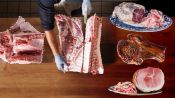
How a Butcher Turns One Pig into 8 Different Pork Products
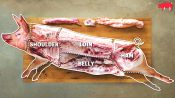
How to Butcher an Entire Pig - Every Cut of Pork Explained

On Our Table: Hayes Street Grill

Miso Avocado Crispbreads

Jalapeño Popper Crispbreads

We Went to Hong Kong’s Number 1 Clay Pot Rice Spot

I Made 65 Meatballs To Create The Perfect Recipe
How I Developed The Perfect Crispy Chicken Sandwich Recipe

This Bangkok Street Omelet is Michelin-Rated
I Baked 192 Lemon Bars to Create the Perfect Recipe